The Myers-Briggs Type Indicator is a test (some people call it a personality test) that refers to one of sixteen types. The system was developed from Jung's work in his Psychological Types.
I've taken the test many times since I discovered (in the mid-1990's) that it was online and free. My results have almost always been the same: INTP
§ I – Introvert / Extravert: INTPs tend to be quiet and reserved; prefer interacting with a close friend or two, and they find social situations draining (whereas extraverts gain energy).
§ N – iNtuitive / Sensing: INTPs tend to enjoy the more abstract concepts, than concrete facts. The big picture is more
important to them than the details, and on future possibilities over immediate realities.
§ T – Thinking / Feeling: INTPs tend to value objectivity over feelings. In decision making, they give logic more weight than their feelings.
§ P – Perceiving / Judging: INTPs tend to delay important decisions, and prefer to keep options open, in case the circumstances change.
According to studies on Canadian and American people, using the Myers Briggs test results for the comparison, most Americans are extraverts whereas the majority of Canadians are introverts. This doesn't really surprise me. I have cousins in the U.S. They are constantly lamenting the energy it takes to pretend extraversion. Of course, my question to them was ... why pretend?
Well, apparently, in some parts of the U.S., introverts are regarded with something akin to suspicion. It's consid
ered "weird", "not normal", and "you could get over it if you would only try".
Well, there's another problem for me. I'm an INTP. What does that mean? Well, in American terms, it means that people like me (according to Keirsey), make up between 1% and 5% of the American population.
But there's worse. I'm an INTP and female. Thinking is considered a very masculine trait.
Women, at least within the parameters of North American culture, are expected to make decisions based on their feelings. I tend to make decisions based on what I think ... and I think the phrase 'get in touch with your feelings' makes me gag. The doctor I used to go to, kept asking me how I felt about how things were going in my life. After a couple of times, I snapped, "Don't ask me how I feel about something. Ask me what I think about it. That, I can answer."
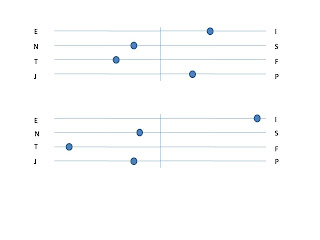
I commented above that I am almost always an INTP. What happened the times I wasn't? One thing to remember about MBTI is that it's not black and white, but more like shades of grey. Sort of like a ruler with its markings between the two extremes. (Shown below.)
I had found a fairly complete version of the test online
and I decided to do the test at the beginning and end of each work day during a high-pressure contract in order to see what changed when I was under stress. The top graph shows where I land normally.
Well, I discovered that, under stress, I become more introverted, more of a thinker, and that I flip from INTP to INTJ. (Bottom graph.)
This explains why, at the beginning of a project, I say "Oh, just send me what you have and I'll slot it in somewhere and build the book from there." But at the end of the project, I'm more likely to say "I told you that the deadline was x. If you don't give me the information by that date, it won't be going into this version of the manual. Enough is enough."
If you are interested in the test, here's an online one that is, I believe, complete.